
How Do Unarmed Guards Handle Suspicious Activity?
Quick answer: Unarmed security guards handle suspicious activity by observing from a safe distance, assessing the actual risk level based on context, communicating what they see to the right person (a supervisor, control room, or police), de-escalating through calm verbal contact when appropriate, and documenting everything. They are trained not to physically confront or restrain anyone — their value comes from early detection and fast, accurate escalation, not physical intervention.
Suspicious activity rarely announces itself. It’s someone lingering too long near a loading dock, a car circling the parking lot twice, a visitor who doesn’t quite match their stated reason for being there. Most of the time these moments turn out to be nothing — but occasionally they’re the early signs of a theft, a break-in, or worse. How a security guard handles that moment, before anything actually happens, is where unarmed security proves its real value.
Professional unarmed security guards are trained to observe unusual behavior, assess risk, communicate concerns, and respond without unnecessary confrontation. Their presence can help businesses detect suspicious activity early while maintaining a safe and professional environment. This makes unarmed guarding a practical option for many commercial and residential properties.
This matters more than most business owners realize when they’re comparing security options. The question isn’t just “will a guard be on-site” — it’s “what will that guard actually do when something looks wrong.” That’s the difference between security that’s decorative and security that’s functional.
The Core Principle: Observe First, React Second
Unarmed security guards are trained to avoid direct engagement as their first response. Instead, they take in details from a safe distance before deciding what needs to happen next.
This isn’t hesitation. It’s the difference between a guard who provides useful, actionable information and one who escalates a situation that might have resolved itself on its own. Rushing toward a person who looks out of place, without first understanding the context, is how minor situations turn into real problems — a confrontation with an innocent visitor, a legal complaint, or a guard placing themselves in genuine danger over something that didn’t warrant it.
Some properties face higher-risk situations where additional security measures may be appropriate. Armed security guard services can provide enhanced protection for locations with valuable assets, elevated threats, or specific security concerns. A professional assessment can help determine whether armed or unarmed coverage is the better fit.
Good observation also means knowing what’s actually normal for a property. A guard who’s worked a site for a few weeks starts to recognize regular delivery trucks, employee patterns, and typical visitor flow — which makes it much easier to spot what doesn’t fit.
If you need reliable protection for your property, employees, or visitors, choose a trusted Security guard company in Albany with experience in professional on-site security. Grand Protective Security provides trained guards, mobile patrols, CCTV monitoring, and customized security solutions for businesses and properties across Albany. Unarmed security guards rely on observation rather than assumptions when identifying potentially suspicious behavior.
Step-by-Step: A Typical Response
1. Observe Without Engaging
The guard notes what’s actually happening — not what they assume is happening. Someone standing near a side entrance could be lost, waiting for a ride, or casing the building. Jumping to conclusions before gathering information leads to bad calls in both directions: overreacting to something harmless, or dismissing something that genuinely needed attention.
Guards are also trained to note specific, useful details rather than vague impressions — a vehicle’s make, color, and license plate; a person’s clothing and direction of travel; the exact time something occurred. These details are what make a report actually useful to police or management later, rather than just a general sense that “something felt off.” This careful approach allows unarmed security guards to gather accurate information before deciding whether escalation is necessary.
2. Assess the Actual Risk Level
Context changes everything. A person walking through a parking lot at 2 p.m. reads differently than the same person doing the same thing at 2 a.m. near a locked gate. Guards are trained to weigh time, location, behavior, and pattern before deciding how seriously to treat what they’re seeing.
This is also where property-specific knowledge matters. A guard who knows the site’s regular delivery schedule, employee shift changes, and typical visitor flow can quickly tell the difference between a normal occurrence and something that doesn’t fit the pattern — which is often the fastest way to catch a real problem early. Unarmed security guards use context, behavior, timing, and property-specific knowledge to assess whether a situation presents a genuine security risk.
3. Communicate Through the Right Channel
Once a guard identifies something worth acting on, the next step is communication — not confrontation. Depending on the security plan, that might mean:
- Radioing another officer on-site
- Notifying management or a shift supervisor
- Contacting law enforcement if the situation clearly warrants it
- Alerting a control room if the property has centralized monitoring
Unarmed security guards are trained to get accurate information to the right person quickly rather than attempting to handle every situation alone.
4. De-escalate When Direct Contact Is Appropriate
Not every suspicious situation calls for a call to police. A confused visitor, a customer dispute, or someone who wandered into the wrong area often just needs a calm, direct conversation. A guard’s presence and tone can resolve these moments without anything else happening — no incident, no injury, no need to involve anyone else.
Effective de-escalation relies on a few habits: staying calm regardless of the other person’s tone, using clear non-confrontational language, giving the person a face-saving way to comply, and knowing when to disengage and call for backup instead. A guard who can defuse a tense moment with words prevents far more problems than one relying on physical presence alone. When appropriate, unarmed security guards use calm communication and professional presence to de-escalate situations safely.
5. Document the Incident
Every observation, however small, gets logged — time, location, description, and what action was taken. This isn’t paperwork for its own sake. A single report might not mean much on its own, but three reports about the same rear door in a month tells a business exactly where its security has a real gap.
Consistent documentation also protects the business itself. If an incident later escalates into a legal or insurance matter, a clear, timely record of what the guard observed and did is often the difference between a straightforward resolution and a drawn-out dispute.
What Suspicious Activity Actually Looks Like
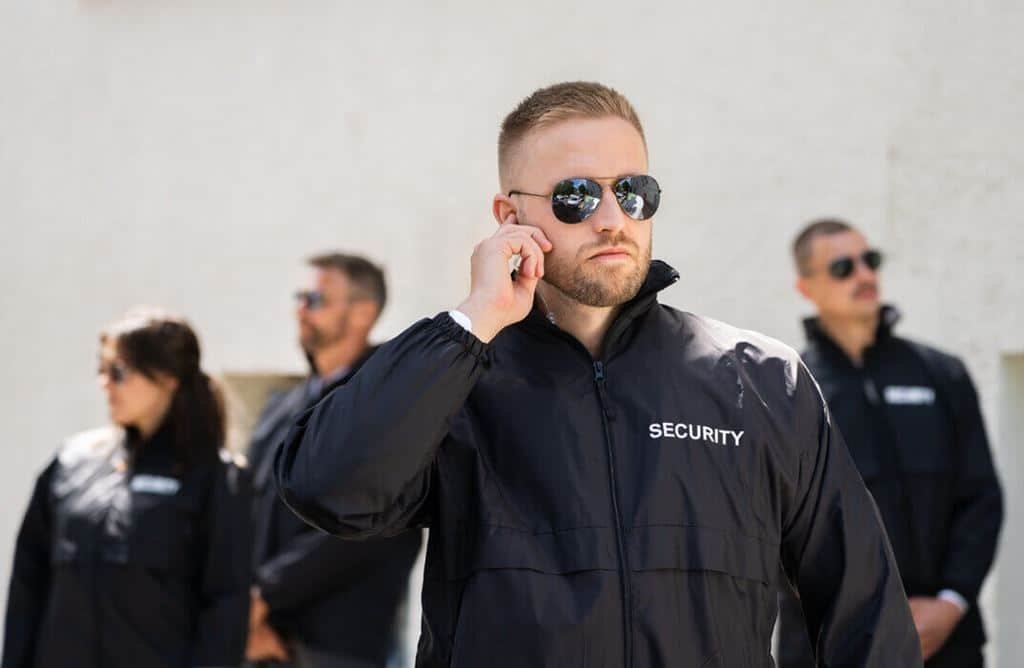
Guards are trained to watch for a range of behaviors, not just obviously alarming ones. Common examples include:
- A vehicle parked in the same spot for an unusually long time, especially near an entrance or loading area
- Someone photographing entrances, cameras, or access points
- A person testing doors or windows without an obvious reason to be there
- Visitors who avoid staffed areas or cameras
- Behavior that doesn’t match the stated purpose of a visit
- Repeated visits at odd hours with no clear business reason
By recognizing these warning signs, unarmed security guards can identify potential risks before they develop into more serious incidents. None of these guarantee something is wrong — that’s exactly why the assessment step matters. The goal is pattern recognition, not assuming the worst about every unfamiliar face on the property.
What the Research Says
The step-by-step process isn’t just industry convention — it’s backed by criminology research. A 2017 randomized controlled trial published in PLOS ONE assigned security patrols to some train stations and not others, and found that the patrolled stations saw a measurable drop in victim-generated crime, with reductions cited around 16% in follow-up analyses of the study. Separate research from retail-focused security groups has found that visible, professional guard presence can reduce theft incidents by up to 30% compared to properties without any visible security.
The underlying mechanism is consistent across these studies: perceived risk of getting caught deters opportunistic offenders more reliably than the threat of punishment after the fact. A guard trained to observe and respond correctly amplifies that effect — not just by being visible, but by creating uncertainty about how quickly and effectively they’ll react to something out of place.
With an Unarmed Guard vs. Without One
The presence of unarmed security guards gives businesses a trained professional who can monitor these situations consistently.
| Situation | No Security Presence | Trained Unarmed Guard |
| Person loitering near an entrance | Goes unnoticed until something happens | Observed, timed, and assessed against normal patterns |
| Vehicle parked repeatedly in the same spot | No one tracks the pattern | Logged after the first instance; flagged if it repeats |
| Confused or lost visitor | Wanders unchallenged or confronts staff directly | Approached calmly and redirected before it becomes a distraction |
| Attempted break-in after hours | Discovered the next morning, if at all | Often interrupted in progress or reported to police in real time |
| Recurring vulnerability (e.g., an unsecured door) | Stays invisible until repeated losses add up | Surfaces in incident reports within weeks, not months |
The difference isn’t dramatic in most cases — it’s cumulative. A property without a trained observer misses the early signals that would have prevented a loss; a property with one catches them.
Why This Approach Works
The value of unarmed security guards isn’t in physical intervention — it’s in early detection, accurate assessment, and timely escalation.
This is also why training matters more than most businesses expect. A guard who over-reacts creates unnecessary friction — false accusations, unnecessary police calls, complaints that damage reputation. One who under-reacts misses the point of having security at all. The right balance comes from clear procedures and knowing exactly when to step back and let the right authority handle it. There’s also a liability angle: a guard who attempts to physically restrain someone can expose the business to legal risk if it goes wrong. Sticking to observation, communication, and de-escalation is safer for everyone involved.
How This Differs From Armed Security
Businesses sometimes assume more serious threats automatically call for armed guards, but the suspicious-activity response process described here is largely the same regardless of whether a guard is armed. The real difference isn’t how they handle a typical situation — it’s the level of threat the property is actually exposed to. For most retail stores, offices, warehouses, and residential properties, the risks involve theft, trespassing, and unauthorized access rather than anything that would call for an armed response. Observation, judgment, and communication solve the vast majority of these situations without a weapon on-site.
What Businesses Should Ask a Security Provider
If suspicious-activity response matters to your property, it’s worth asking a provider directly:
- What’s the guard’s standard procedure when they notice something unusual?
- At what point do they contact law enforcement versus handling it themselves?
- How and when are incidents documented and reported to management?
- How is de-escalation training handled, and how often is it refreshed?
- Can the guard walk through a recent example of how they handled a real situation?
A provider who can answer these clearly — with specific examples, not just general reassurances — is one whose guards will actually know what to do in the moment, not just how to walk a patrol route.
A Real-World Example
In situations like this, unarmed security guards can help businesses identify suspicious patterns before they develop into more serious security incidents. Consider a retail store that had noticed the same unfamiliar car parked near its rear entrance three evenings in a row, always around closing time. On its own, a parked car means nothing. But the guard on duty had logged it after the first night as part of routine observation, noticed the repeat pattern on the second, and by the third evening flagged it to the shift manager and kept a closer watch on that entrance during closing procedures.
Nothing dramatic happened — no confrontation, no police call. But the pattern was enough to prompt the store to add motion-activated lighting near that entrance and adjust the guard’s patrol timing around closing. That’s the unarmed-security model working as intended: not a dramatic intervention, but early observation turned into a small, practical fix before it became a real incident.
Common Mistakes That Undermine a Guard’s Response
Even well-intentioned security programs can fall short if a few basics are missed:
- Vague post orders. If a guard isn’t told clearly what counts as suspicious and what to do about it, response quality varies from shift to shift.
- No clear escalation chain. A guard who doesn’t know exactly who to call, and in what order, wastes critical time during an actual incident.
- Inconsistent documentation. Incomplete or late incident reports lose most of their value for spotting patterns.
- One-size-fits-all training. A guard suited to a quiet office lobby needs different judgment calls than one working an overnight warehouse shift.
Fixing these is usually a matter of clearer procedures and better provider oversight — not more guards or more equipment.
The Role of Ongoing Training
Suspicious-activity response isn’t something a guard learns once and retains forever. Situations vary, and judgment sharpens with experience and refresher training. Reputable providers build in periodic scenario-based training — walking through realistic examples of trespassing, theft attempts, or aggressive visitors — so guards aren’t relying purely on instinct when something actually happens. Ask not just whether training exists, but how recently it was updated and how it’s reinforced on the job.
Frequently Asked Questions
Can an unarmed guard physically stop someone acting suspiciously? No. Unarmed guards are trained to observe, assess, and escalate — not to physically restrain or confront. Their role is to get accurate information to management or law enforcement quickly, not to intervene physically.
What happens if a guard sees an actual crime in progress? Standard protocol is to avoid direct confrontation, move to a safe position, and immediately contact law enforcement while continuing to observe and document from a distance if it’s safe to do so.
How do guards tell the difference between suspicious and normal behavior? Mainly through context and pattern recognition — knowing a property’s regular traffic, delivery schedule, and visitor flow well enough to notice when something doesn’t fit, rather than reacting to any unfamiliar face.
Do all security companies train guards the same way for suspicious activity? No. Training quality varies significantly between providers. Ask specifically about post orders, escalation procedures, and how often de-escalation training is refreshed before hiring.
Is an unarmed guard less effective than an armed one at handling suspicious activity? Not for the situations most businesses face. The observation-assessment-communication process is nearly identical for armed and unarmed guards — the real difference is the level of threat a property is exposed to, not how a typical suspicious situation is handled.
Conclusion
Unarmed security guards aren’t meant to physically stop a threat. They’re meant to notice it early, judge it correctly, and get the right people involved before it becomes a bigger problem. That combination of observation, judgment, and communication — not confrontation — is what makes a trained unarmed guard valuable, and it’s worth confirming any provider you hire actually trains for it.